
In a mechanical watch there is no battery; instead, power is generated when you wind the crown, turning the mainspring within the barrel. The mainspring is a very long, thin strip of spring steel which is twisted up tight when you turn the crown. Unlike a battery, the spring is designed to slowly unwind and provide its energy over time. However, the spring’s power is not sent directly to the watch hands. There is a series of gear trains that convert the mainspring’s high-torque output into something that can drive the watch hands.
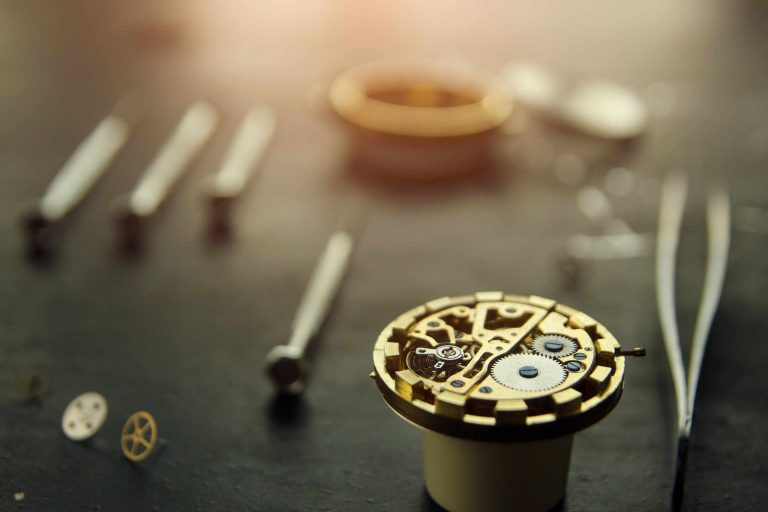
The first major component to recognize is the barrel. As the spring unwinds, it turns the barrel. The barrel’s teeth mesh with another wheel which, in turn, meshes with another. With a loupe you can see how the various wheels of the movement have different sizes and tooth profiles. The sizes of the gears are carefully chosen so that the speed of rotation is converted over the course of multiple steps until the output can actually turn the hands.
However, even with the gearing, the barrel will still try to rotate much too quickly. To prevent that, we use the escapement to break down the energy from the mainspring into small increments. When viewed with a loupe you will see the escape wheel and pallet fork. The pallet fork locks the teeth of the escape wheel then unlocks them allowing it to advance one tooth before locking again. This action is what gives a watch its ticking sound. Rather than letting all of the power from the spring dissipate instantly, the escapement forces the energy to flow through it in small pulses.
Next, we meet the heart of the watch: the balance wheel and hairspring. The hairspring expands and contracts as the balance wheel rotates back and forth. This back-and-forth rotation causes the pallet fork to unlock and lock the escape wheel repeatedly, allowing it to advance one tooth at a time. The balance wheel and hairspring thus keep the entire system going. But they’re not self-sustaining. The escape wheel periodically sends a pulse of energy to the balance wheel to keep it moving. These two components need to be properly aligned and well-lubricated for the system to work. Thus, for your first few attempts you should avoid touching these components with your tweezers.
There is a simple exercise you can do without removing any components. If you have a cheap mechanical movement you can place it in a movement holder and look through a loupe. You should see the barrel, and all the visible components of the gear train. Next, find the balance wheel and watch how it moves when the movement is running. Wind the crown and see what happens. Don’t actually touch the hairspring, escape wheel, or balance wheel with your tweezers; just observe. What you want to do is trace the path of power through the movement and understand where it all comes from and where it goes. You don’t want to try to test these delicate components by poking them with your tweezers.
Sometimes new watchmakers think they need to push harder or apply more oil when a component doesn’t move freely. Often, the problem isn’t a lack of oil but a poorly fitted pivot, misaligned bridge, bent wheel tooth, or dirt in the mechanism. For example, if a bridge sits slightly off-kilter before the screws are tightened, the movement’s gears will bind together. When you are assembling a movement, you should verify that each bridge rests naturally on the mainplate before tightening its screws. Sometimes, gently turning the gears around will verify that they move freely. Forcing them, however, can cause damage, either bending a pivot or marking a gear tooth.
At this point, a good indicator that you are making progress is that you can describe a movement’s function as a chain. The power source stores the energy, the barrel delivers it, the gear train transmits it, the escapement regulates it, and the balance wheel controls the rate. Once you understand this basic chain, recognizing individual components becomes much easier. When you see a running movement again, try to trace the path of power from the crown all the way to the ticking of the escapement and you’ll notice how the power becomes the passage of time.